Add power to a car and the clutch is often the first part to complain. A standard clutch is designed to hold the standard engine’s torque with a sensible safety margin. Raise the torque with a remap or a turbo upgrade, and that margin can disappear. The first sign is usually slip in a high gear at full throttle, the revs rising without the speed following.
This guide covers the types of uprated clutch, the case for and against a lightweight flywheel, and how to choose the right combination for your car.
How a clutch holds torque
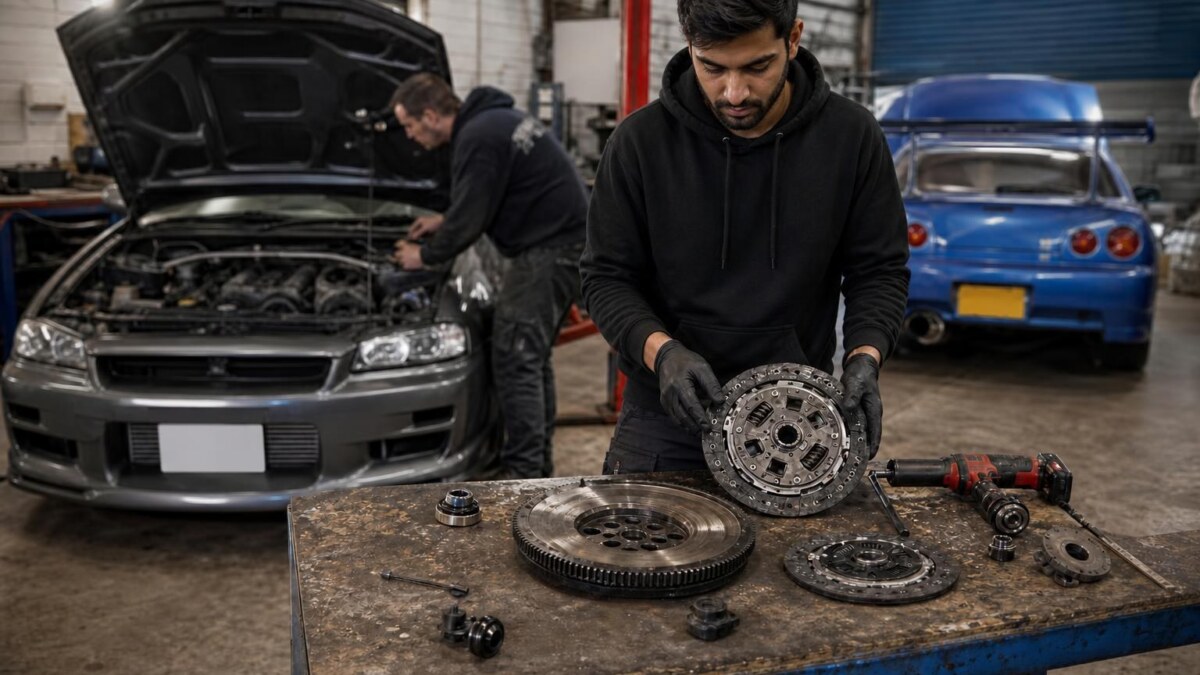
The clutch disc is clamped between the flywheel and the pressure plate. How much torque it can hold depends on three things: the clamping force of the pressure plate, the friction of the disc material and the diameter of the disc. Uprated clutches improve one or more of these.
Types of uprated clutch
| Type | Torque capacity | Pedal and engagement | Road manners | Typical use |
|---|---|---|---|---|
| Uprated organic | Moderately higher than standard | Slightly heavier pedal, smooth take-up | Excellent | Remapped road cars |
| Kevlar or carbon-faced | Higher | Smooth, long life when bedded in | Very good | Fast road and track days |
| Ceramic or sintered, full face | High | Firmer pedal, sharper bite | Fair, can judder when cold | Big power road cars |
| Paddle (button) ceramic | Very high | On or off, little slip | Poor in traffic | Competition and drag cars |
| Twin or triple plate | Very high, compact | Varies, can be noisy | Fair to poor | High power competition cars |
For most modified road cars, an uprated organic or Kevlar clutch with a stronger pressure plate is the right answer. It holds the extra torque without turning every hill start into a challenge. Paddle clutches make sense only on cars that see more track than traffic.
Lightweight flywheels
The flywheel smooths out the engine’s power pulses and stores energy, which helps the car pull away without stalling. A lighter flywheel stores less energy, so the engine revs up and down faster. That makes gear changes quicker and gives the car a crisper, more eager feel.
The downsides are the other side of the same coin. A light flywheel makes pulling away easier to stall, idle can be a little less smooth, and some cars develop gear rattle at low revs. On a car that spends a lot of time in traffic, a very light flywheel can become tiring.
Dual-mass flywheels
Many modern cars, especially diesels and torquey petrol engines, use a dual-mass flywheel. It has two halves joined by springs to absorb vibration. Dual-mass flywheels are expensive to replace, and many owners swap to a solid single-mass flywheel when the clutch is done. That saves money and handles more torque, but expect more vibration and noise through the car. Conversion kits designed for the car do the best job of keeping that under control.
Choose the clutch for the worst traffic jam you will sit in, then check it still holds the torque.
Dan Whitlock
Choosing the right set-up
| Car and use | Clutch | Flywheel |
|---|---|---|
| Remapped daily driver | Uprated organic | Standard or solid conversion |
| Fast road with track days | Kevlar or uprated organic | Moderately lightened |
| Big turbo road car | Full-face ceramic or twin plate | Lightened, matched to the clutch |
| Dedicated track car | Paddle or twin plate | Lightweight |
Always tell the clutch maker the engine’s real torque figure after tuning, not just the power. Torque is what the clutch has to hold.
Fitting and bedding in
Replace the release bearing and spigot bearing at the same time as the clutch. Check the flywheel bolts are new where the maker requires it, and torque them to the correct figure with thread lock if specified.
Most uprated clutches need a bedding-in period, often several hundred miles of gentle driving with no launches or full-power changes. Skipping it can glaze the friction material and shorten the clutch’s life dramatically.
Signs your clutch is struggling
- The revs rise without the speed following at full throttle in a high gear.
- A burning smell after hill starts or hard driving.
- The biting point has moved much higher up the pedal travel.
- Judder when pulling away that was not there before.
If you see these after a remap, stop using full throttle until the clutch is replaced. A slipping clutch gets hot quickly and can damage the flywheel face, turning a clutch job into a more expensive one.